

There is a particular kind of institutional contribution that does not announce itself in press releases or board appointments. It accumulates quietly, over decades, in the form of decisions made at the right moment, crises navigated without drama, and a presence so woven into an organisation’s fabric that it becomes difficult, eventually, to imagine the institution without the person. Mrs. Rose Oriaran-Anthony is that kind of public servant.
She arrived at the Independent National Electoral Commission (INEC) in 1990, not as a lawyer or a political operative, but as a Public Affairs Officer. She came with a first degree in Education and the instincts of a communicator, and she brought with her something that would prove more durable than any formal qualification: a genuine commitment to the institution she had joined and to the democratic mandate it carried.
At the time, INEC’s headquarters were still in Lagos. In 1991, when the Commission relocated to Abuja, it was Oriaran-Anthony who served as Liaison Officer for that transition, a role that placed her at the centre of one of the most logistically complex moments in the organisation’s early history, and which signalled, early in her career, that she was someone institutions turned to when the work was consequential and the margin for error was small.
What followed was a career of unusual breadth. She served as the Commission’s Chief of Protocol, as Chief Information Officer, as INEC Website Content Manager, roles that together span the full spectrum of institutional communication, from ceremony to digital infrastructure to media strategy.
In the Department of Voter Education, Publicity, Gender and Civil Society Organisation Liaison, she held successive leadership positions: Deputy Director in charge of the Gender Division, Deputy Director overseeing Civil Societies Liaison, and eventually Director of Voter Education with responsibility for civil society engagement, youth mobilisation, and the inclusion of persons with disabilities in Nigeria’s electoral process.

Each role extended her institutional footprint in a different direction, deepening her understanding of INEC not merely as an administrative body but as a democratic instrument, one whose credibility depends, more than most people appreciate, on how well it communicates, how inclusively it engages, and how faithfully it builds trust with the citizens whose votes it exists to protect.
Her appointment as Administrative Secretary of INEC Delta State, and subsequently as Secretary to the Commission itself, was not a departure from the career she had built. It was its culmination,the moment the institution formally placed its most senior administrative confidence in the woman who had served it for nearly three decades. Her portfolio in that role, corporate communication management, institutional governance, cross-departmental coordination, draws on every chapter of the career that preceded it.
But what makes Oriaran-Anthony’s story genuinely distinctive is not the titles. It is the texture of the person behind them. She is, by all accounts, a thoroughly detribalised Nigerian in the most complete and unselfconscious sense of that phrase, an Edo indigene with roots spread across many parts of the country, speaking, reading, and writing in major Nigerian languages with a fluency that is as much relational as it is linguistic.
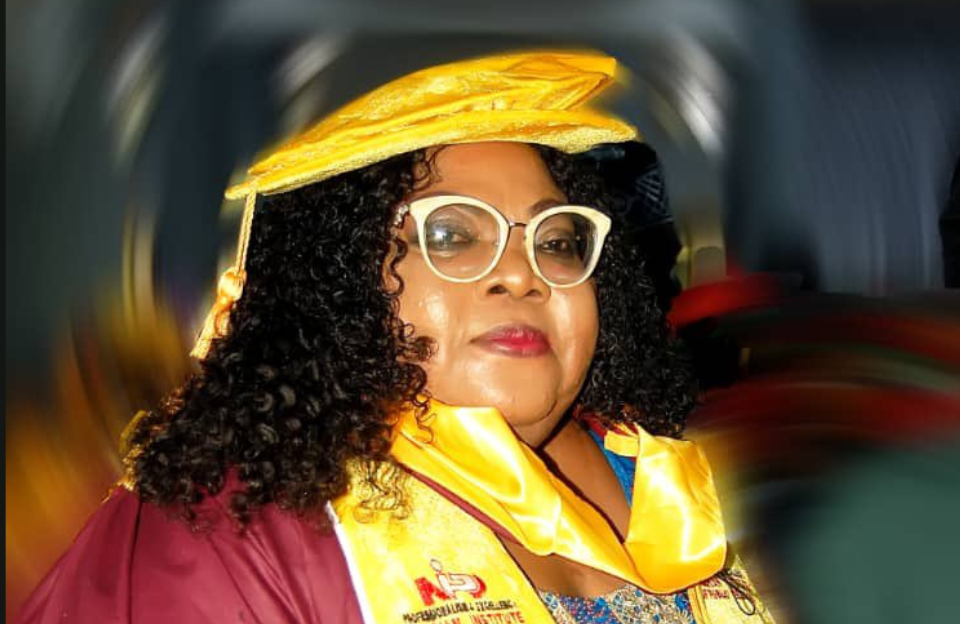
In 2010, the Sarkin Edo in Minna, Niger State, recognised her compassionate and motherly disposition with the honorary title of Gimbiya– a designation that speaks not to her professional rank but to the quality of her human presence. It is the kind of honour that no career milestone can manufacture, and no appointment can confer. It is earned in the way all enduring reputations are earned: through consistent character, expressed across years.
She is well-travelled, widely read, passionate about mentoring, and, by her own account, as committed to the people she guides as she is to the institution she serves. In a democracy that is still being built , still negotiating the distance between its founding promise and its daily practice , institutions like INEC need people who understand both the technical architecture of electoral governance and the human work of making citizens believe that their participation matters. Mrs. Rose Omoa Oriaran-Anthony has spent her career doing both.

