
Across Africa, rising interest in sustainable finance is creating fresh opportunities to direct capital toward development priorities, including gender equality and women’s economic empowerment. For UN Women, capturing this opportunity takes more than crafting new financial instruments — it means equipping financial institutions with the capacity to understand, design, evaluate and implement financing approaches that weave gender considerations into investment and capital mobilisation.
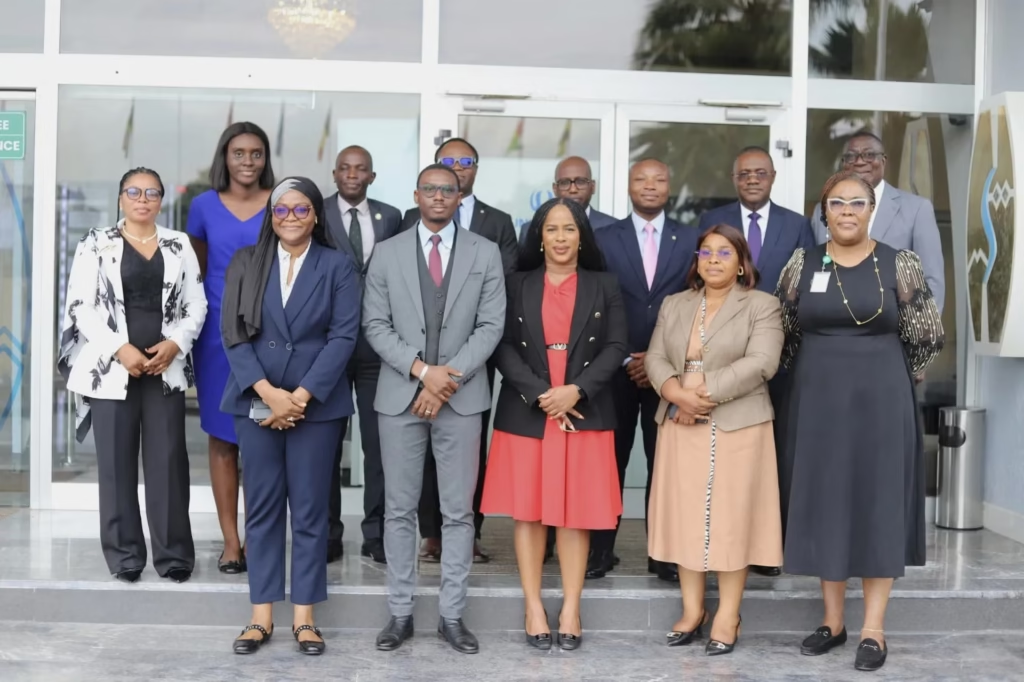
That was the focus of a recent capacity-building initiative between UN Women and the ECOWAS Bank for Investment and Development (EBID) in Lomé, Togo. The programme convened EBID’s senior leadership and technical teams to build deeper understanding of sustainable finance and gender-responsive financing tools, while exploring how these approaches could support the Bank’s wider institutional and development agenda.
Turning Gender Finance Theory Into Action
Gender-responsive finance spans a variety of approaches and instruments that can help direct capital into investments advancing gender equality — including gender bonds, social and sustainability bonds, gender-lens investment strategies, and other sustainable finance tools shaped by gender-related goals, eligibility criteria and impact measures. Rather than zeroing in on one specific product, the Lomé sessions centred on building the institutional knowledge needed to properly assess and apply these approaches.
Participants reviewed the global and regional gender finance landscape, alongside international market benchmarks such as the International Capital Market Association (ICMA) principles.
The programme also referenced UN Women’s guidance materials, including Bonds to Bridge the Gender Gap: A Practitioner’s Guide to Using Sustainable Debt for Gender Equality; a case study series on innovative financing for gender equality via bonds; and Gender Bonds: A Toolkit for the Design and Issuance of Gender Bonds in Africa (available in French and English).
Closing the Financing Gap for Women
Even as Africa’s financing needs grow, the resources channelled toward gender equality remain far from adequate.
Women entrepreneurs across the continent face an estimated $42 billion financing gap — one that, if closed, could add up to $316 billion to Africa’s GDP. The task isn’t just about raising the volume of available capital, but about strengthening the systems that decide how that capital gets allocated.
Financial institutions, including regional development banks like EBID, are well placed to drive this shift by embedding gender considerations into investment strategies, financing frameworks, project pipelines and impact measurement.
“The opportunity is not simply to create more gender-labelled financial products. It is to strengthen the financial ecosystem so that capital can systematically identify, finance and measure investments that advance women’s economic empowerment,” said Ijeoma Madueke, CFA, Strategic Advisor, Sustainable Finance, UN Women West and Central Africa Regional Office.
“Working with UN Women has sharpened our understanding of what it takes to move from ambition to execution on gender-responsive finance. It has also reinforced the importance of embedding these considerations systematically — across our investment processes, our project pipelines and our institutional decision-making.
READ ALSO: LIBERIA HONORS ITS WOMEN, PEACE AND SECURITY LEGACY AT UNGA
As EBID continues to expand its role in the region’s sustainable finance ecosystem, we see this as foundational work, not a one-off initiative,” said Dr Francis G. Ezin, Director of Administration and General Services at EBID.
Building Toward Broader Market Change
The work with EBID feeds into UN Women’s larger effort to strengthen sustainable finance ecosystems across West and Central Africa. The next phase of collaboration will centre on ongoing technical support — including reinforcing institutional frameworks, scoping eligible project pipelines, and supporting governance and implementation where needed.
UN Women’s ambition is to help shape financial systems where gender equality becomes a built-in feature of how capital is mobilised, allocated and measured.

