
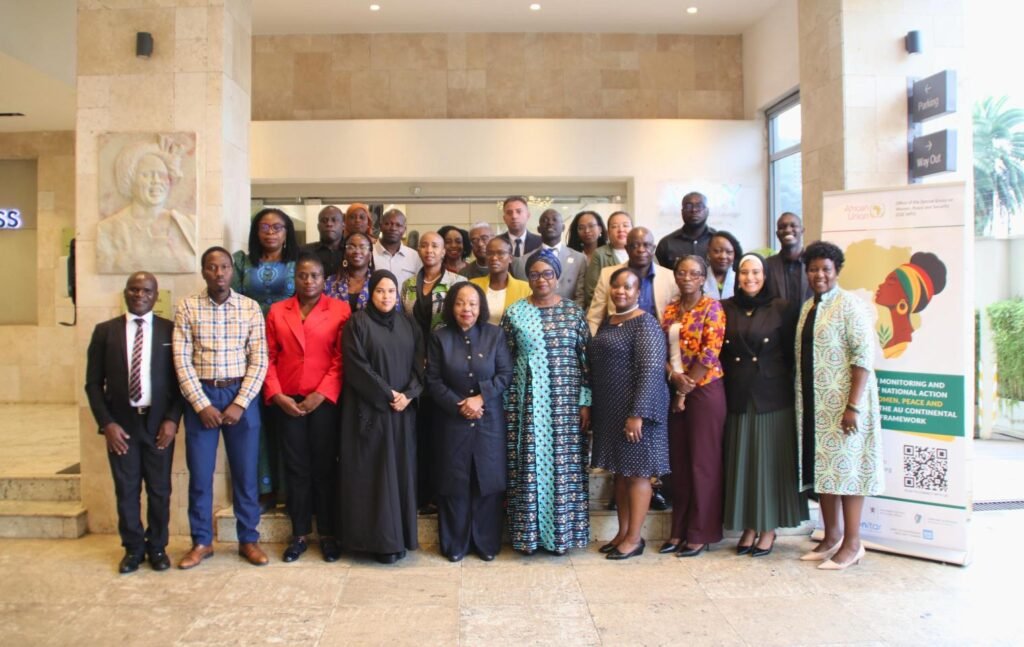
The African Union Commission (AU), through the Office of the Special Envoy on Women, Peace and Security (OSE-WPS), has begun training a first group of Member States, Regional Economic Communities (RECs) and Regional Mechanisms (RMs) on how to track and report progress on their National Action Plans (NAPs) for Women, Peace and Security, using the AU’s Continental Results Framework (CRF). The five-day pilot course is running in Nairobi, Kenya, from 21 to 25 September 2026.
The course targets a gap that has held back the Women, Peace and Security (WPS) agenda. Member States have made real headway in drafting WPS policies and Action Plans — 37 now have NAPs in place, and 20 are currently reporting through the CRF — but many still struggle to monitor those commitments consistently, gather solid evidence and report on outcomes. Closing that gap is critical if the AU wants a clearer, more reliable picture of progress across the continent.
Speaking on her behalf, Dr. Sally Wangamati delivered opening remarks from AU Special Envoy H.E. Ambassador Liberata Mulamula, who said a National Action Plan is only as good as its execution.
“The success of a National Action Plan cannot be measured by its adoption alone; its true value is reflected in implementation,” she said, pointing to whether commitments get funded, institutions follow through, women are genuinely involved, protections improve, and outcomes can actually be demonstrated.
She added that this is exactly why the AU places such weight on monitoring and reporting: they reveal where things are working, where gaps remain, and where more attention is needed — turning promises into proof.
The Office of the Special Envoy said strong monitoring and reporting systems are essential to bridging the gap between what governments commit to and what they actually deliver. Better national and regional capacity to collect, analyse and report WPS data will lead to smarter decisions, stronger accountability, and a clearer view of both achievements and shortfalls across Africa.
In her keynote, Lady Justice (Rtd) Effie Luhombo Owuor of the African Union Panel of the Wise said the WPS Agenda is ultimately about delivering real change for women and girls.
“Monitoring and reporting are not just technical exercises — they are matters of leadership, accountability and learning,” she said, adding that behind every data point is a human story, and good evidence helps show what’s working, what isn’t, and how to do better.
READ ALSO: MINET KENYA APPOINTS CAROLE NDERITU AS NEW CHIEF OPERATING OFFICER
The CRF is the main tool the OSE-WPS uses to hold the WPS agenda accountable — giving everyone a shared way to track progress and compare results, gaps and emerging priorities. This training is meant to help Member States and regional bodies actually put the CRF to use.
Participants are learning practical ways to monitor and report on their NAPs, how to apply CRF indicators and meet reporting requirements, how to collect and use WPS data, and how to work directly with the CRF’s digital reporting platform. They’ll also trade notes on shared challenges and work through solutions that fit their own contexts. The training is one part of a larger OSE-WPS effort to build accountability, strengthen institutions, and root WPS implementation in solid evidence — alongside continued work with Member States, RECs, RMs and civil society to turn continental commitments into action on the ground.

