
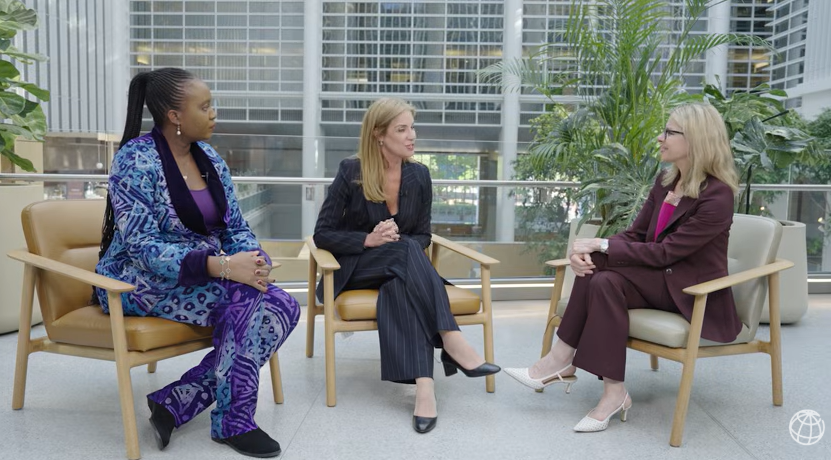
The World Bank Group has announced a new partnership with the Visa Foundation aimed at accelerating support for women-owned small businesses in developing economies, with a strong focus on access to finance, skills development, and scalable opportunities.
In a recent episode of the World Bank’s Talking Development series, World Bank Managing Director Anna Bjerde sat down with Kelly Tullier, Vice Chair, Chief People and Corporate Affairs Officer at Visa and Chair of the Visa Foundation, and Adesuwa Okunbo Rhodes, Founder and Managing Partner of Aruwa Capital Management, to discuss the critical role women entrepreneurs play in job creation and economic growth, and the persistent barriers they face.
Small businesses account for up to 90% of jobs in developing countries, with women entrepreneurs playing a vital role in driving growth and strengthening communities. However, limited access to capital, skills, and networks continues to hinder their potential.
A Shared Commitment to Inclusive Growth
Kelly Tullier emphasised the natural alignment between Visa’s purpose and the World Bank’s mission.
“At Visa, our purpose is to uplift everyone everywhere by being the best way to pay and be paid,” Tullier said. “Small businesses are at the heart of what we do at the Visa Foundation.”
Over its nearly 10-year existence, the Visa Foundation has invested $350 million across 150 organisations, supporting 13 million small businesses and helping 14 million people secure jobs worldwide. The new partnership with the World Bank seeks to scale these efforts significantly.
Adesuwa Okunbo Rhodes shared powerful insights from her work at Aruwa Capital Management, which has deliberately focused on women-led businesses across Africa. With 70% of its portfolio consisting of female-founded or female-led companies, Aruwa has delivered impressive results: average revenue growth of 26 times, top-quartile financial returns, and significant valuation uplifts when portfolio companies raise subsequent funding.
ALSO READ: ROSE MUTURI: DRIVING MONIEPOINT’S EXPANSION AND THE FUTURE OF DIGITAL FINANCE IN KENYA
Beyond Capital: The Power of Holistic Support
A key theme throughout the conversation was that access to capital alone is not enough. Women entrepreneurs need skills, networks, financial education, and technical assistance to scale sustainably.
Tullier highlighted Visa Foundation’s focus on financial literacy, digital skills, and building trust and security for entrepreneurs entering the formal economy. Rhodes stressed the importance of partnerships across the capital continuum and technical assistance in areas such as marketing, operations, and finance functions.
The panel also addressed structural gaps, including the “missing middle” in SME financing and the need for greater mobilisation of local capital, particularly from pension funds.
A Ladder of Opportunity
Anna Bjerde underscored the World Bank’s ambition to provide capital to 80 million more women and women-led businesses by 2030. The new partnership aims to remove barriers, scale proven solutions, and create a stronger ladder of opportunity for women entrepreneurs.
By combining capital, capacity building, and strategic partnerships, the collaboration seeks to unlock the enormous economic potential of women-led businesses — delivering both strong financial returns and broad-based development impact.

