
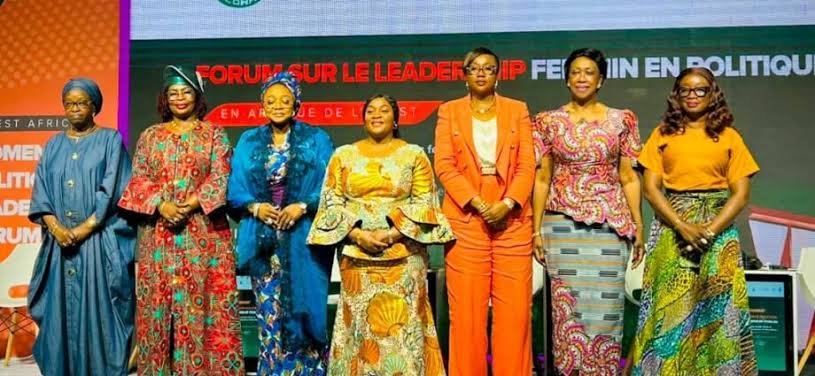
The United Nations Development Programme (UNDP) has renewed calls for targeted financing tools including a proposed women’s political endowment fund to break down the money barriers that keep women out of politics across West Africa.
The recommendation featured prominently in the Abuja Action Agenda, a communique adopted at the Women’s Political Leadership Forum held Friday in the Nigerian capital under the theme “Accelerating Gender Parity in Political Leadership in West Africa.”
The event was convened by the African Women Leaders Network (AWLN), working alongside UNDP, the Economic Community of West African States (ECOWAS), and Nigeria’s Ministry of Women Affairs.
Speaking at the forum, Jide Okeke, UNDP’s Director of Programmes for Africa, described women as essential to leadership, peacebuilding, security, and sustainable development yet still held back by poor access to political funding.
He shared a personal reflection, crediting his mother’s investment in his education for shaping his own path to leadership within the UNDP system, and argued that stronger female leadership translates directly into stronger peace and security outcomes across the continent.
Okeke noted that women hold just 18 percent of parliamentary seats across West Africa, a figure he called far too low given the region’s stated commitment to gender parity and inclusive governance.
To help close that gap, he said UNDP has set up a Women’s Political Participation Academy, which will soon train 40 women political leaders drawn from 28 countries in Kigali. The agency has already trained roughly 140 young African women through its Young Women Leaders Programme, building their capacity for public service roles.
Okeke added that UNDP is working with the African Union to dismantle financing obstacles and build sustainable funding structures for women running for office. “In countries like Nigeria, women want a level playing field. I hope this meeting endorses dedicated funds for promoting and supporting women in politics,” he said.
Nigeria’s Minister of Women Affairs, Hajiya Imaan Sulaiman-Ibrahim, described the Abuja Action Agenda as a shift from rhetoric to action, aligning with the country’s broader goals around inclusive governance, institutional reform, economic empowerment for women, peacebuilding, and democratic participation.
“Gender equality is no longer an emotional conversation but an economic necessity. No nation can achieve inclusive development while women remain excluded from governance,” she said, pointing to Nigeria’s ongoing rollout of its Third National Action Plan on Women, Peace and Security and its review of a proposed Special Seats Bill meant to boost women’s representation in elective office.
ECOWAS Commission Vice-President Damien Tchintchigbidja said the regional body is prepared to help member states turn gender commitments into domestic policy through reform and accountability measures, but stressed that “achieving gender parity requires collective ownership, stronger partnerships and measurable accountability from governments and stakeholders.”
Sierra Leone’s Minister of Gender and Children’s Affairs, Dr. Isata Mahoi, pointed to her country’s Gender Equality and Women’s Empowerment Act, along with reforms to political party regulation and national election law, as evidence that legislation, economic empowerment, and mentorship can meaningfully shift women’s political participation.
Liberia’s Minister of Gender, Children and Social Protection, Gbeme Horace-Kollie, singled out campaign financing as one of the biggest obstacles blocking women from winning elective office, calling for dedicated funding, lower nomination fees, and broader electoral reform. She urged governments to legally require political parties to offer equitable campaign financing and support specifically for female candidates.
READ ALSO: STANDARD BANK NAMIBIA CHAMPIONS WOMEN LEADING NEW INNOVATION IN TECHNOLOGY
AWLN Co-Convener Bineta Diop closed out the discussion by stressing that real gender parity depends on a full ecosystem, effective laws, strong institutions, engaged political parties, adequate financing, mentorship, and accountability sustained through coordinated action among governments, regional bodies, and women’s movements.
By the end of the forum, participants had formally adopted the Abuja Action Agenda, committing governments, regional institutions, and development partners to strengthen legislation, financing, mentorship, and accountability mechanisms for women in political leadership, a framework organizers hope will accelerate gender parity across West Africa in the years ahead.

