
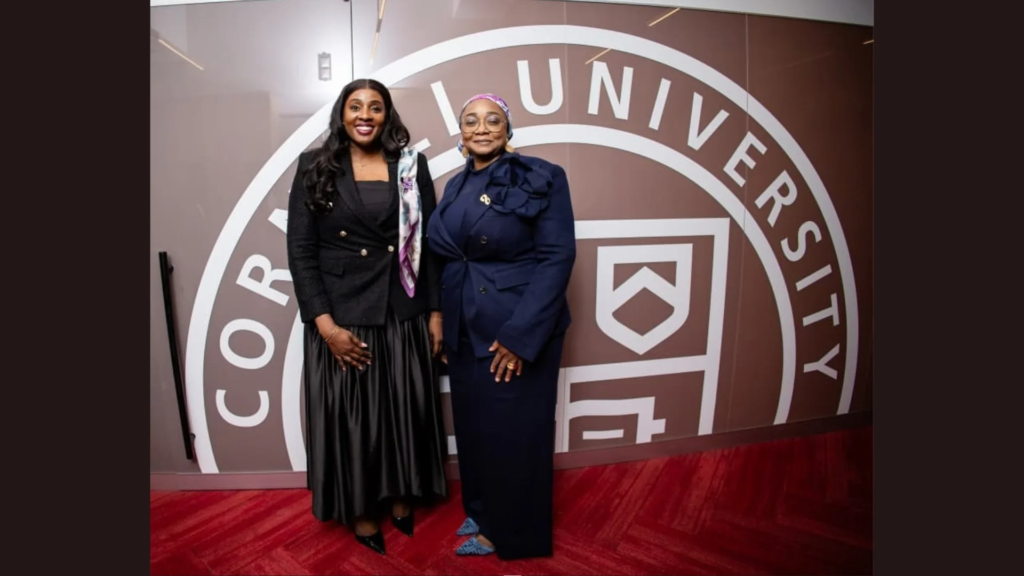
Nigeria’s Minister of Women Affairs, Imaan Sulaiman-Ibrahim, has urged closer cooperation among government, businesses and development organisations to open routes for women into technology, artificial intelligence, financial services, clean energy and other high-value sectors.
She said efforts to empower women economically should go beyond programmes that treat them mainly as beneficiaries. Policies, she argued, should also help women become business owners, producers, innovators and players across major economic value chains.
Sulaiman-Ibrahim spoke in New York on the margins of the 81st session of the United Nations General Assembly, at an event convened by Vivacity Development.
The event was one of several held around UNGA 81, whose high-level meetings drew government officials, development institutions, businesses and civil society groups to the city.
Vivacity Development’s programme was themed “Work, Innovation and Opportunity: Preparing the Next Generation for the Global Economy.” Discussions centred on skills, investment, innovation and economic opportunities for Africa’s young population.
Speaking to participants, Sulaiman-Ibrahim said government policy would achieve more if paired with private-sector expertise, investment and hands-on skills training.
“We have to put heads together, the government and practitioners, to provide various pathways and entry points for women,” she said.
“Women should not only be beneficiaries of initiatives like clean cooking; they must be empowered to fabricate the technology, own the local skills, and access multi-million dollar credit tools to build real economic power.”
Her comments drew a line between women as consumers or recipients of development programmes and women as producers and owners of businesses in the industries those programmes serve.
Taking clean cooking as an example, the minister said that widening women’s access to cleaner energy should come with chances for them to take part in the economic value chain behind it.
That could mean acquiring technical skills, starting businesses, manufacturing or assembling the relevant technologies, and getting access to finance.
She said the same principle should apply to emerging and fast-growing sectors such as technology, artificial intelligence and fintech.
Sulaiman-Ibrahim maintained that government cannot create these opportunities alone at the scale needed.
She called for better coordination among policymakers, private-sector operators and development organisations, with government providing enabling policies and businesses and practitioners turning them into commercially viable opportunities.
The minister also pointed to the Federal Government’s push to raise women’s participation in public procurement.
She cited a 35 per cent affirmative procurement target meant to widen opportunities for women-owned and women-led enterprises in government contracting.
Procurement has become a growing part of the conversation on women’s economic participation, since government purchasing can give businesses access to large markets.
Still, meeting such targets depends on more than policy commitments. Implementation, awareness among women-owned businesses, access to procurement information and the ability of smaller firms to meet bidding and compliance requirements all matter.
The event’s convener, Oluwakemi Ann-Melody Areola, who is Chief Executive Officer of Vivacity Development, said sustainable economic mobility would call for stronger coordination among governments, investors and skills-development organisations.
“Building sustainable economic mobility requires more than isolated interventions; it demands intentional alignment between government policy, private capital, and practical skills development,” Areola said.
“Our goal through this platform is to ensure young women and youth are not just included in the conversation, but are equipped to compete and lead in the global marketplace.”
Vivacity Development built its UNGA programme around preparing younger Africans for shifts in the global economy, especially as technology changes the nature of work and creates new demands for skills and entrepreneurship.
The organisation has also used its international engagements to link skills development with access to capital and cross-border investment.
Its New York programme followed an Investors Connect event in London earlier in September, which aimed to connect entrepreneurs with investors, mentors and international partners.
For Sulaiman-Ibrahim, the test is whether policies meant to support women end up producing measurable economic participation.
Her argument puts more weight on ownership and productive participation than on counting the beneficiaries that government or development programmes reach.
That distinction matters more as artificial intelligence, financial technology and the energy transition create new industries and reshape existing ones.
Women who are trained only to use new technologies risk capturing a small share of the economic value those sectors produce.
Helping women develop technology, manufacture equipment, offer professional services, build companies and secure investment could put them at more profitable stages of emerging value chains.
READ ALSO: ALITHEIA CAPITAL, 300 WOMEN-LED BUSINESSES PUSH FOR NEW FINANCING MODELS
Such ambitions, however, need more than policy statements.
Affordable finance, digital and technical skills, reliable infrastructure, markets, mentorship and transparent procurement systems all influence whether women-owned businesses can compete and grow.
The minister’s call for a joint approach therefore assigns responsibility to several groups.
Government can build policy and financing frameworks. Private-sector organisations can supply market opportunities, investment, technical knowledge and commercial partnerships. Development organisations can offer training, research and programmes aimed at removing barriers to participation.
The difficulty lies in bringing these efforts together instead of letting them run separately.
Across UNGA 81, economic inclusion, technology and investment have featured heavily in discussions on Africa’s development. UNDP, for instance, has raised questions about who owns the infrastructure behind artificial intelligence, who captures the economic value of African resources and talent, and how entrepreneurs can get better access to capital and markets.

